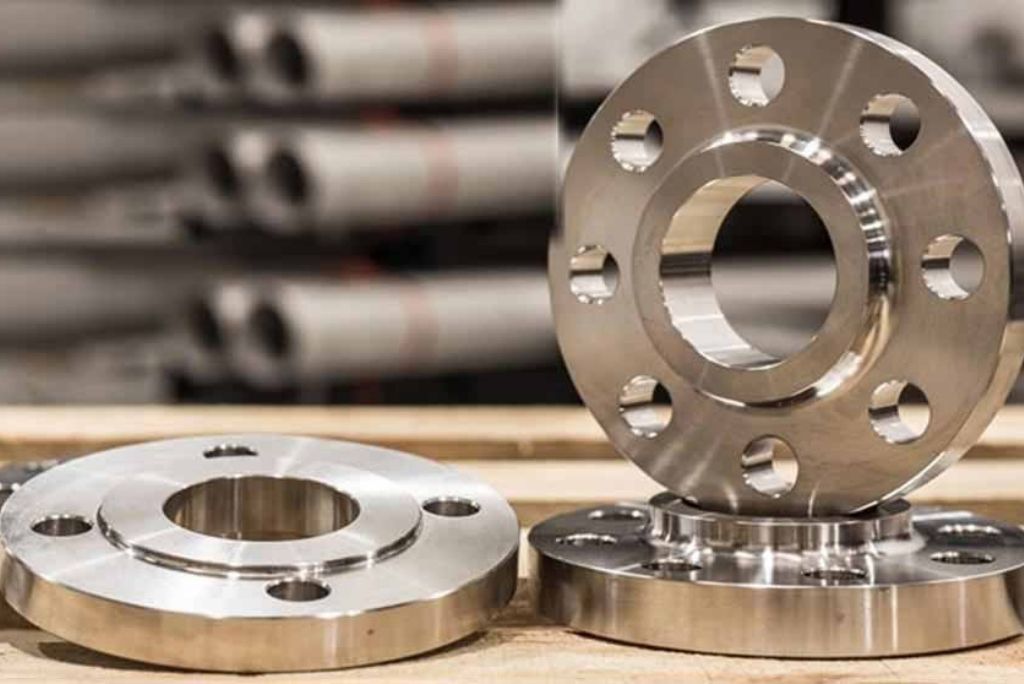
Description
STANDARD TYPES OF FLANGES
With over 6 years of experience and hundreds of flanges shipped each year, Teknotek is dedicated to meeting all of your pipe flange needs. In addition, with significant exports to The Middle East customers, we have gained a good reputation in pipe flange field. The type of flange to be used for a piping application depends, mainly, on the required strength for the flanged joint. Flanges are used, alternatively to welded connections, to facilitate maintenance operations (a flanged joint can be dismantled quickly and conveniently). Let’s now dive in, showing the key types of flanges with pictures.WELDING NECK FLANGE
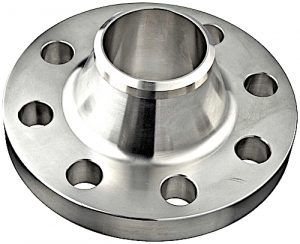 .
.  A welding neck flange (“WN”)features a long tapered hub that can be welded with a pipe.
This flange type is used, normally, in high-pressure and high/low temperatures applications that require an unrestricted flow of the fluid conveyed by the piping system (the bore of the flange matches with the bore of the pipe).
The absence of pressure drops prevents negative effects as turbulence and erosion/corrosion of the metals in the proximity of the flanged joints.
The tapered hub allows a smooth distribution of the mechanical stress between the pipe and the weld neck flange and facilitates the execution of radiographic inspections to detect possible leakages and welding defects.
The dimension of the flange (NPS and the pipe schedule) shall match the dimension of the connecting pipe.
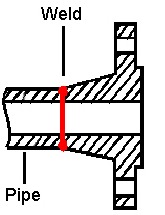
A welding neck flange is connected to a pipe by a single full penetration V-shaped butt weld.
A welding neck flange (“WN”)features a long tapered hub that can be welded with a pipe.
This flange type is used, normally, in high-pressure and high/low temperatures applications that require an unrestricted flow of the fluid conveyed by the piping system (the bore of the flange matches with the bore of the pipe).
The absence of pressure drops prevents negative effects as turbulence and erosion/corrosion of the metals in the proximity of the flanged joints.
The tapered hub allows a smooth distribution of the mechanical stress between the pipe and the weld neck flange and facilitates the execution of radiographic inspections to detect possible leakages and welding defects.
The dimension of the flange (NPS and the pipe schedule) shall match the dimension of the connecting pipe.
A welding neck flange is connected to a pipe by a single full penetration V-shaped butt weld.
LONG WELDING NECK
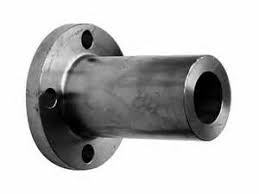 Long weld neck flanges (“LWN”) are similar to weld neck flanges, with the exception that the neck (tapered hub) is extended and acts like a boring extension.
SLIP ON FLANGE
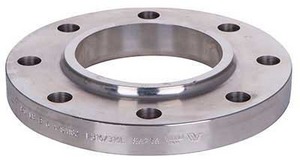
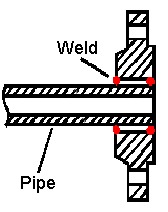 A slip-on flange is connected to the pipe or the fittings by two fillet welds, one executed inside and one outside the cavity of the flange.
The bore size of a slip-on flange is larger than the outside diameter of the connecting pipe, as the pipe has to slide inside the flange to be connected by the execution of a fillet weld.
Slip-on flanges are also defined “Hubbed Flanges” and they are easy to recognize due to their slim and compact shape.
The dimensions and weights of slip-on flanges ANSI/ASME are available on this page.
WELD NECK VS SLIP ON FLANGE
Flanged joints made with slip-on flanges are, in the long run, a bit more fragile than connections made with welding neck flanges (in similar service conditions). This seems due to the following facts:
A slip-on flange is connected to the pipe or the fittings by two fillet welds, one executed inside and one outside the cavity of the flange.
The bore size of a slip-on flange is larger than the outside diameter of the connecting pipe, as the pipe has to slide inside the flange to be connected by the execution of a fillet weld.
Slip-on flanges are also defined “Hubbed Flanges” and they are easy to recognize due to their slim and compact shape.
The dimensions and weights of slip-on flanges ANSI/ASME are available on this page.
WELD NECK VS SLIP ON FLANGE
Flanged joints made with slip-on flanges are, in the long run, a bit more fragile than connections made with welding neck flanges (in similar service conditions). This seems due to the following facts:
- a welding neck flange features a tapered hub, absent in a socket weld flange, which distributes the mechanical stress between the pipe and the flange more evenly
- a welding neck joint as only one welding area instead of two (socket weld flange).
THREADED FLANGE
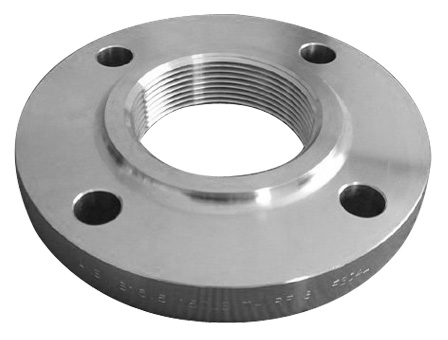
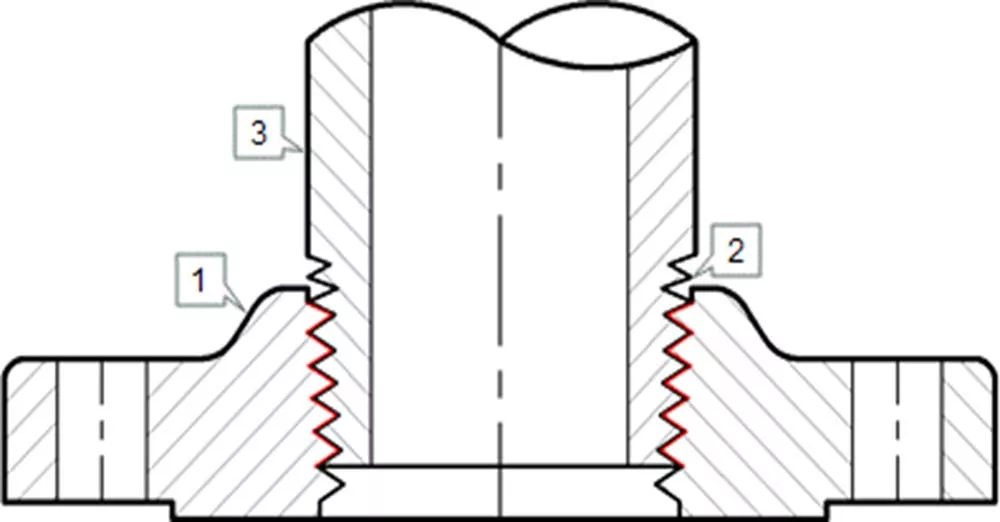 Threaded flanges are joined to pipes by screwing the pipe (which has a male thread, generally NPT per ASME B1.20.1) onto the flange, without seam welds (in certain cases, though, small welds are applied to increase the strength of the connection).
Threaded flanges are available in sizes up to 4 inches and multiple pressure ratings, however, they are used, mostly, small size piping in low pressure and low-temperature applications, like water and air utility services.
Threaded flanges are also a mandatory requirement in explosive areas, such as gas stations and plants, as the execution of welded connections in such environments would be dangerous.
Threaded flanges are joined to pipes by screwing the pipe (which has a male thread, generally NPT per ASME B1.20.1) onto the flange, without seam welds (in certain cases, though, small welds are applied to increase the strength of the connection).
Threaded flanges are available in sizes up to 4 inches and multiple pressure ratings, however, they are used, mostly, small size piping in low pressure and low-temperature applications, like water and air utility services.
Threaded flanges are also a mandatory requirement in explosive areas, such as gas stations and plants, as the execution of welded connections in such environments would be dangerous.
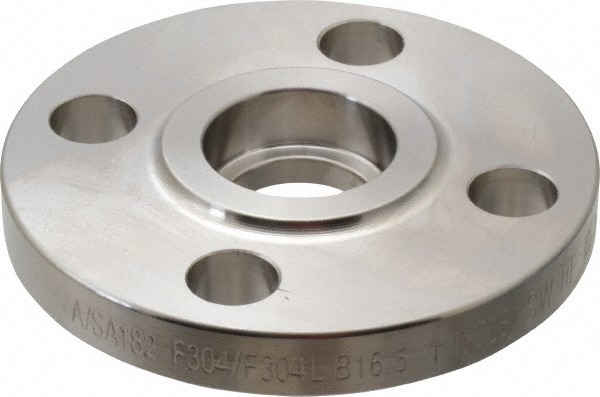
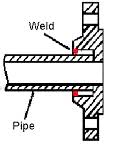
SOCKET WELD FLANGE
 .
. 
LAP JOINT FLANGE
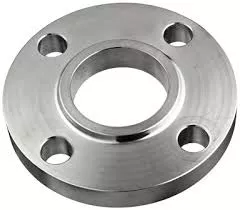
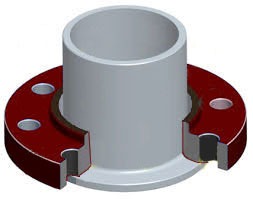
- reduces the overall cost of the pipeline’s flanged joints, as the use of higher grade materials is minimized;
- bolting operations are simplified, as the lap joint flange can be rotated around the pipe to help with bolts alignment.
BLIND FLANGE
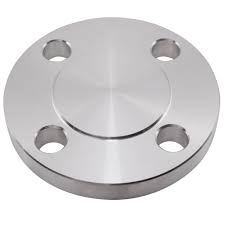 Contrary to all the flange types seen above, blind flanges do not have a center hole, and are used to blind or seal a pipeline, a valve/pressure vessel and block the flow of the fluid.
Blind flanges have to withstand remarkable mechanical stress due to the system pressure and the required bolting forces.
Blind flanges allow easy access to the pipeline, as they can be easily unbolted to let the operator execute activities inside the terminal end of the pipe (this is also the reason why the blind flange type is used as manhole for pressure vessels, at times).
It is maybe interesting to observe that, while this flanges type is easier to manufacture, they are sold at a premium average cost per kilogram compared to the other flange types.
Contrary to all the flange types seen above, blind flanges do not have a center hole, and are used to blind or seal a pipeline, a valve/pressure vessel and block the flow of the fluid.
Blind flanges have to withstand remarkable mechanical stress due to the system pressure and the required bolting forces.
Blind flanges allow easy access to the pipeline, as they can be easily unbolted to let the operator execute activities inside the terminal end of the pipe (this is also the reason why the blind flange type is used as manhole for pressure vessels, at times).
It is maybe interesting to observe that, while this flanges type is easier to manufacture, they are sold at a premium average cost per kilogram compared to the other flange types.
SPECIAL TYPES OF FLANGES
NIPOFLANGE
WELDOFLANGE
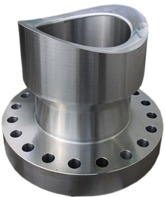
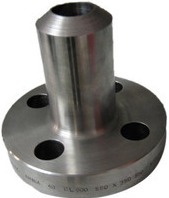
A Weldoflange is conceptually similar to a Nipoflange, as that they are a combination of a weld neck flange and a branch fitting connection (a Weldolet in this case). Weldoflanges are made out of a single piece of solid forged steel, not by welding separate parts together.
ELBOFLANGE AND LATROFLANGE
Other less common types of flange Olets is the so-called Elboflange (a combination of a flange and an Elbolet) and “Latroflange” (combination of a flange with a Latrolet). Elboflanges are used to branch a pipeline at 45 degrees.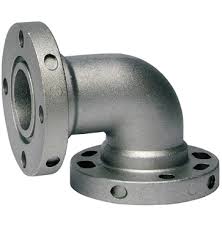
SWIVEL FLANGE
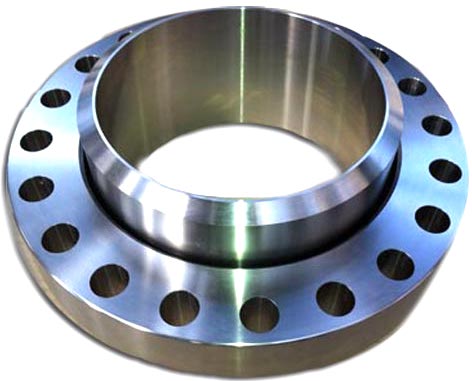
Swivel ring flanges facilitate the alignment of the bolt holes between the two mating flanges, a feature that is helpful in many circumstances, such as the installation of large diameter pipelines, subsea and offshore pipelines, pipe works in shallow waters and similar environments.Swivel flanges suit oil, gas, hydrocarbons, water, chemical and other demanding fluids in petrochemical and water management applications.In the case of a large diameter pipeline, for instance, the pipe is fitted, at one end, with a standard welding neck flange, and with a swivel flange at the other end: by simply rotating the swivel flange on the pipe, the operators can achieve a perfect alignment of the bolt holes in a way easier and faster way.
The major standards for swivel ring flanges are ASME/ANSI, DIN, BS, EN, ISO, etc. The most common standard for petrochemical application is the ANSI/ASME B16.5 or ASME B16.47.
EXPANDING FLANGE (“EXPANDER”)
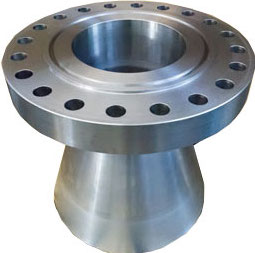
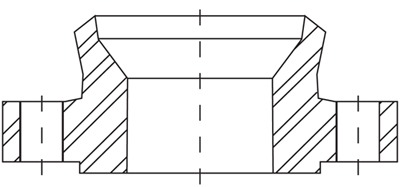 The drawing of an ASME expanding flange.
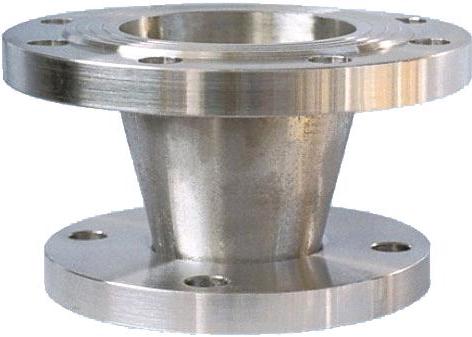
REDUCING FLANGE (“REDUCER”)
OTHER FLANGE CLASSIFICATIONS
The shape is the most obvious way to classify the different types of flanges. However, other ways to classify flanges exist and they are:
- by material grade
- by flange face type (raised, flat, ring joint, male and female, tongue and groove, lap joint)
- by flange finish (smooth, serrated, stock)
- by dimensions (nominal size and pressure rating)
Reviews
There are no reviews yet.